Insurance by Industry
Insurance Built for Technology Firms
From software startups to established IT service providers, tech businesses face liability and data risks that standard business policies rarely cover on their own.

Technology firm insurance is a combination of coverages designed specifically for businesses that develop, sell, or support technology products and services, protecting them against professional liability claims, data breaches, equipment failures, and the everyday exposures that come with running any commercial operation.
Standard business policies were written for general commercial risks. A software developer whose code causes a client's system to go down, or an IT managed-services firm whose technician accidentally exposes a client's customer data, faces liability scenarios that a basic general liability policy may not address. Bittick works with multiple carriers to piece together a program that fits what your firm actually does, whether you're a SaaS startup in Meridian's fast-growing tech corridor or a cybersecurity consultancy operating out of the San Antonio metro.
Your technology firm faces unique risks that standard business insurance doesn't fully cover.
From cyber breaches to professional negligence claims, we help you build a protection plan tailored to how you actually operate.
What this coverage includes
Professional liability (errors and omissions)
Professional liability, often called E&O in the tech world, covers your firm when a client claims your work caused them a financial loss. That could mean software that failed to perform as specified, a missed deadline that knocked out a product launch, or advice that led a client to make a costly decision. This coverage pays legal defense costs and any covered settlement, regardless of whether the claim has merit. For technology firms, it is typically the most critical piece of the coverage puzzle.
Cyber liability
Cyber liability coverage responds when a data breach, ransomware attack, or other cyber event hits your systems or the systems you manage for clients. It can cover notification costs (many states, including Idaho, require you to notify affected individuals), forensic investigation, credit monitoring for those impacted, and legal defense if a client or regulator comes after you. It also addresses incidents you may inadvertently cause, such as malware that spreads from your network to a client's environment.
Commercial general liability and property
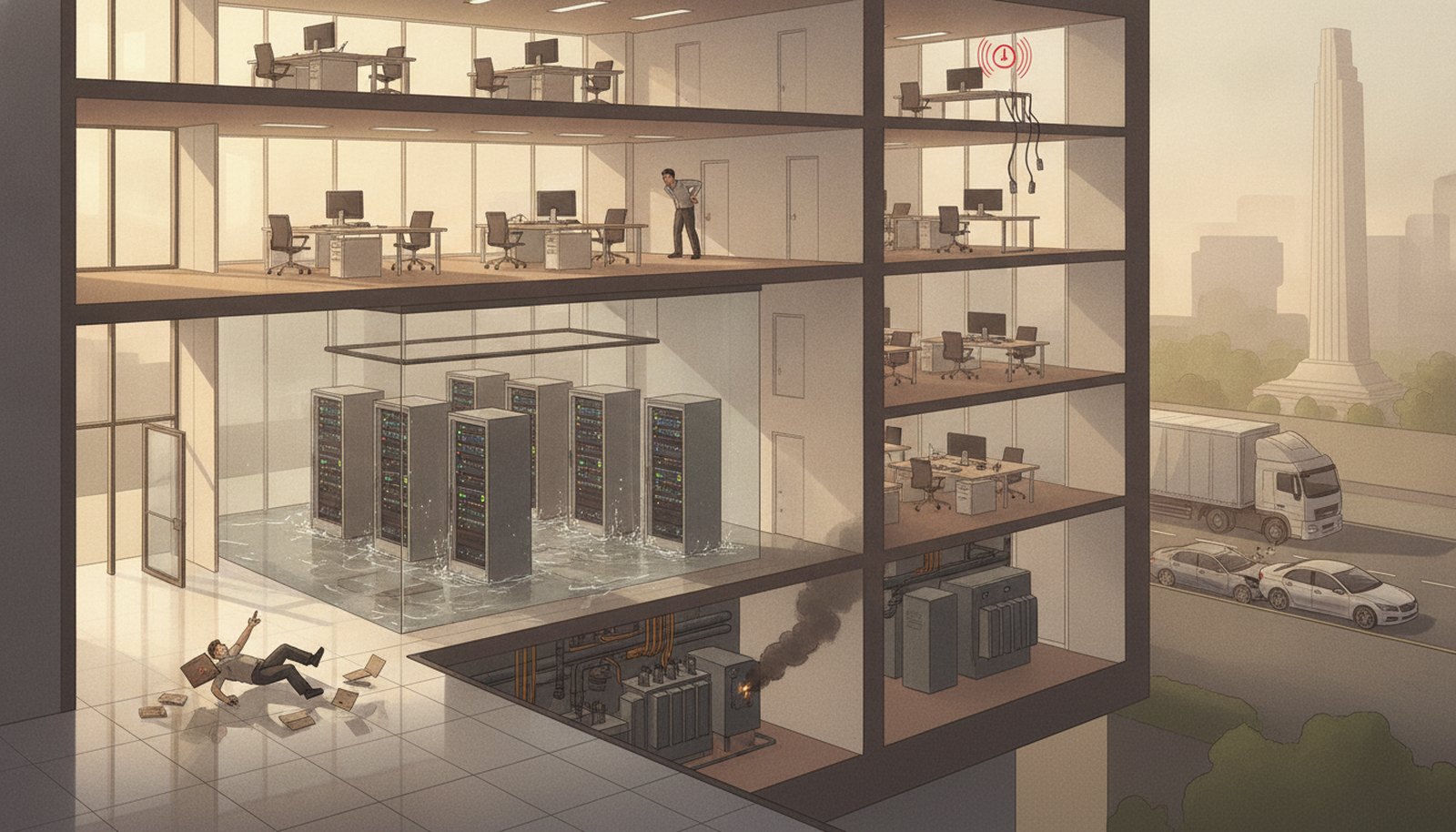
General liability covers bodily injury and property damage claims that happen at your office or because of your business operations. A visiting client who trips over a server cable, a vendor whose laptop gets damaged during a site visit, a dispute over advertising content, these are the kinds of third-party claims general liability is built for. Commercial property coverage protects the physical assets your firm depends on: servers, workstations, networking gear, and office fixtures, whether you own your space or lease it in a shared office building.
Systems breakdown and business income
Systems breakdown coverage fills a gap that basic property insurance leaves open: mechanical or electrical failure of your core equipment. When a power surge fries your server rack or a critical HVAC unit fails and takes the server room with it, this coverage pays for repairs and the income you lose while operations are interrupted. Business income coverage extends that protection further, compensating for lost revenue when a covered property event forces you to suspend or scale back operations while the damage is repaired.
Commercial umbrella and workers compensation
A commercial umbrella policy sits above your general liability, business auto, and other underlying policies to extend the total limit available on a large claim. Settlements in technology liability cases can reach well into the millions; an umbrella adds a second layer, typically from $2 million to $10 million, without requiring you to buy separate high-limit policies for each line. Workers compensation is required by Idaho law for most employers and covers medical expenses and lost wages when an employee is injured on the job, whether that happens in the office or at a client site.
Pairs well with
Errors and Omissions (E&O) Insurance
E&O is purpose-built for professional service claims and should always accompany a tech firm's general liability policy. General liability alone does not cover financial losses your clients suffer because your product or advice fell short.
Learn more ›Cyber Liability Insurance
Even firms with strong internal security face exposure through third-party vendors or employee error. A standalone cyber policy covers notification costs, forensic response, and client lawsuits that E&O may exclude when the trigger is a security event rather than a performance failure.
Learn more ›Commercial General Liability Insurance
Every business needs a general liability foundation. For tech firms it covers the physical and personal-injury claims that fall outside the professional scope, including incidents at your office or at a client's location.
Learn more ›Commercial Property Insurance
Servers, workstations, and networking equipment represent significant capital investment. Commercial property coverage protects that hardware against fire, theft, vandalism, and certain weather events.
Learn more ›Workers Compensation Insurance
Required by Idaho law for most employers, workers comp covers medical treatment and wage replacement when an employee is injured or becomes ill because of their work, whether that work happens in the office or at a client site across the valley.
Learn more ›Commercial Umbrella Insurance
Technology liability claims can exceed standard policy limits quickly. An umbrella policy extends coverage over your underlying lines and is often the most cost-efficient way to reach the limits a sophisticated client or contract may require.
Learn more ›