Insurance by Industry
Insurance built for schools, not just buildings
From the classroom to the parking lot, Bittick helps schools across Idaho and Texas place coverage that matches how they actually operate.

School insurance is a bundle of commercial coverages designed specifically for educational facilities, addressing the physical campus, the people in it, the data it stores, and the legal exposures that come with supervising minors and employing staff. A standard business policy rarely covers all of that. A school in Eagle or Meridian running a after-school program, managing a fleet of volunteer drivers, and storing student records in the cloud faces a very different risk profile than a retail shop or a contractor. Bittick is an independent agency licensed in CA, CO, ID, NV, OR, TX, VA, and WA, and we work with multiple carriers to build programs for public, private, and charter schools.
Your school faces unique risks that demand comprehensive protection.
From physical damage to liability to cyber threats, we help you safeguard your students, staff, and operations.
What this coverage includes
Building and business personal property
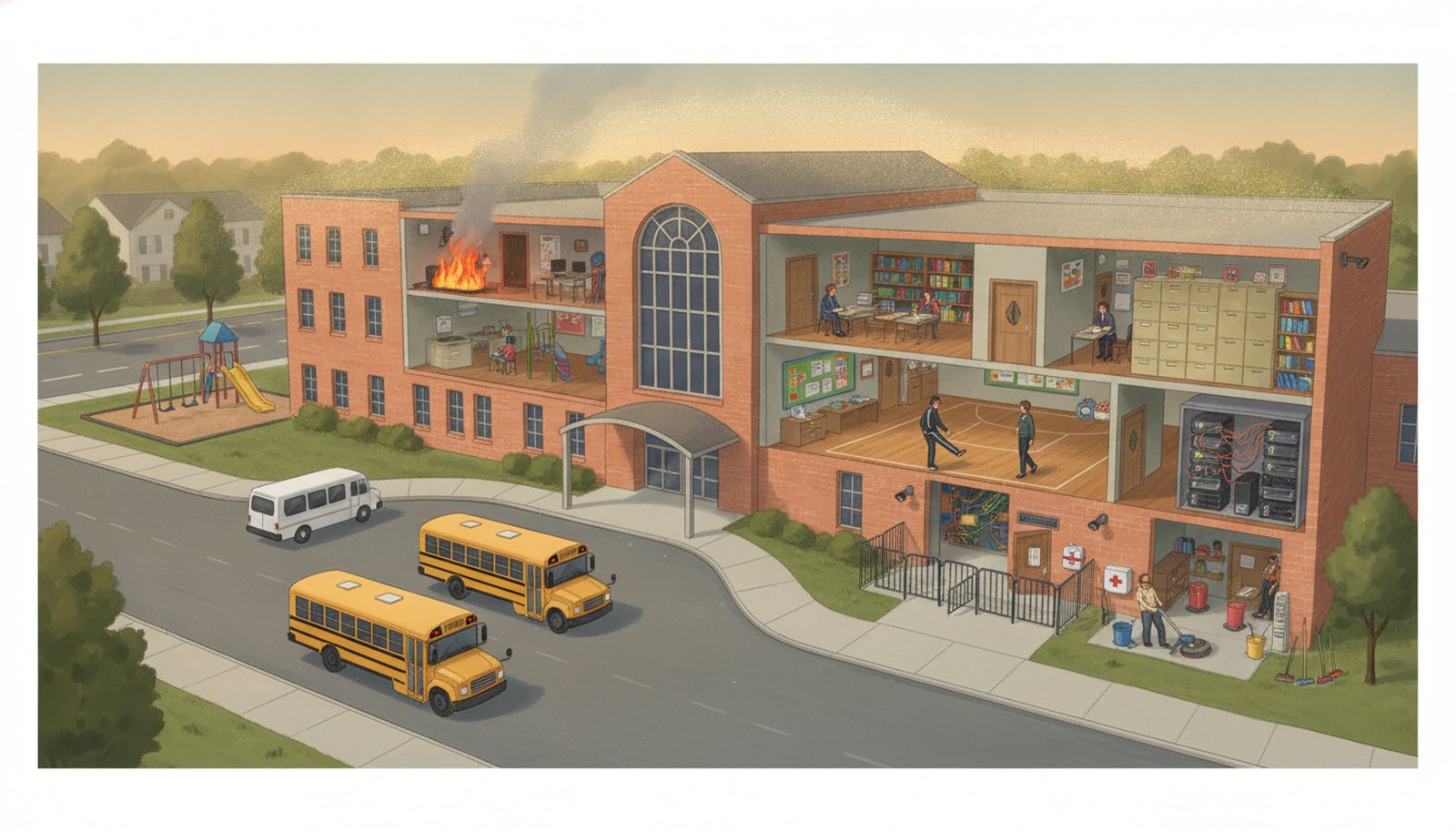
Your campus buildings, portable classrooms, and the contents inside them (desks, chairs, lab equipment, books, kitchen appliances) all require separate coverage. Building coverage protects the permanent structure against fire, burst pipes, wind, hail, and most weather perils. Business personal property coverage steps in when classroom contents are damaged or destroyed by a covered loss. For a school on the Treasure Valley's clay-heavy soil, where freeze-thaw cycles stress foundations and rooflines, both layers matter.
Business income and extra expense
If a fire or a burst pipe forces you to close the campus, income stops but obligations don't. Business income coverage replaces the revenue or operating funds you lose while the building is being repaired. Extra expense coverage pays for the added cost of running classes at a temporary site so instruction can continue. This is especially relevant for private and charter schools where tuition revenue is the operating lifeline.
General liability and abuse and molestation coverage
General liability covers bodily injury and property damage claims that arise from school operations, including a visitor who slips in the hallway or a teacher who accidentally damages a student's device. But general liability alone almost never covers allegations of abuse or molestation. Abuse and molestation coverage is a separate endorsement or policy, and it is one that any school supervising minors needs to carry. Schools should also maintain written protocols for reporting and prevention alongside this coverage.
Educator's legal liability and employment practices
Board members, directors, and administrators can be held personally liable for decisions involving discrimination, wrongful termination, negligent supervision, or misuse of school funds. Educator's legal liability (ELL) insurance defends those individuals under the school's policy rather than leaving them to fund their own defense. Employment practices liability covers the school itself against claims from current or former employees alleging harassment, discrimination, or wrongful termination. Most volunteer board members should require ELL coverage before agreeing to serve.
Cyber liability, crime, and crisis response
Schools collect sensitive data on students and families and often manage fundraiser cash with limited controls. Cyber liability covers unauthorized access to your network, data breaches, extortion, and unintentional employee errors that expose information. Crime and employee dishonesty coverage protects against theft of cash raised through fundraisers or misappropriation by staff. Crisis response coverage reimburses costs like public relations counsel and counseling services after a violent incident on campus, events that general liability policies typically exclude.
Pairs well with
Commercial Auto / Hired and Non-Owned Auto
When staff or volunteers use personal vehicles to transport students or run school errands, the school can be exposed if those drivers cause an accident. Hired and non-owned auto coverage fills the gap that personal auto policies often leave in business-use situations.
Learn more ›Workers' Compensation
Idaho and Texas both require employers to carry workers' compensation for employees. A teacher injured moving furniture or a custodian hurt during a campus repair needs medical coverage and wage replacement that this policy provides.
Learn more ›Commercial Umbrella
A serious liability claim against a school can easily exceed the limits on a standard general liability or auto policy. A commercial umbrella extends coverage over multiple underlying policies, typically adding two to ten million dollars in additional limits.
Learn more ›Employment Practices Liability
Harassment, discrimination, and wrongful-termination claims from current or former staff are a real exposure for any employer, and schools are no exception. EPLI covers legal defense costs and settlements that arise from these employment-related claims.
Cyber Liability Insurance
Schools store student records, financial aid data, and staff personal information, making them an increasingly targeted sector for ransomware and data theft. A standalone cyber policy covers breach response costs, regulatory notifications, and extortion demands that standard property policies exclude.
Learn more ›